Is your personality type rare or common? How do demographics change between cultures? While online communities often celebrate rare types, demographic analysis reveals fascinating national differences—especially between Japan and Western populations.
Using our interactive MBTI Distribution & Rarity Rankings Tool, you can filter and compare real demographic data across markets. Below is the complete breakdown.
1. Japan MBTI Population Distribution Ranking (Top 16)
Based on aggregated Japanese online test samples, here is how the 16 types rank in frequency:
| Rank | Type | Title | Japan % | Personality Group |
|---|---|---|---|---|
| 1 | INFP | Mediator | 16.44% | Diplomats (NF) |
| 2 | ENFP | Campaigner | 13.79% | Diplomats (NF) |
| 3 | INTP | Thinker | 7.19% | Analysts (NT) |
| 4 | ISFJ | Defender | 6.81% | Sentinels (SJ) |
| 5 | INFJ | Advocate | 6.79% | Diplomats (NF) |
| 6 | ESFJ | Consul | 6.74% | Sentinels (SJ) |
| 7 | ISFP | Adventurer | 6.74% | Explorers (SP) |
| 8 | ESFP | Entertainer | 6.01% | Explorers (SP) |
| 9 | ENFJ | Protagonist | 5.59% | Diplomats (NF) |
| 10 | ENTP | Debater | 5.18% | Analysts (NT) |
| 11 | INTJ | Architect | 3.69% | Analysts (NT) |
| 12 | ISTJ | Logistician | 3.57% | Sentinels (SJ) |
| 13 | ESTJ | Executive | 3.38% | Sentinels (SJ) |
| 14 | ISTP | Virtuoso | 2.87% | Explorers (SP) |
| 15 | ESTP | Entrepreneur | 2.62% | Explorers (SP) |
| 16 | ENTJ | Commander | 2.57% | Analysts (NT) |
2. Why Are INFP and ENFP So Common in Japan?
Having over 30% of a population identifying as INFP or ENFP is unprecedented in global personality research. Two primary factors account for this:
Cultural and Self-Selection Factors
- Cultural Harmony: Traditional Japanese values emphasize empathy, modesty, and reading social nuance, which strongly resonate with Feeling (F) preferences.
- Self-Selection in Online Quizzes: Introspective, identity-curious types (INFP/ENFP) are significantly more likely to voluntarily seek out and complete online personality questionnaires.
3. Japan vs Global: The Dominance of SJ Types Worldwide
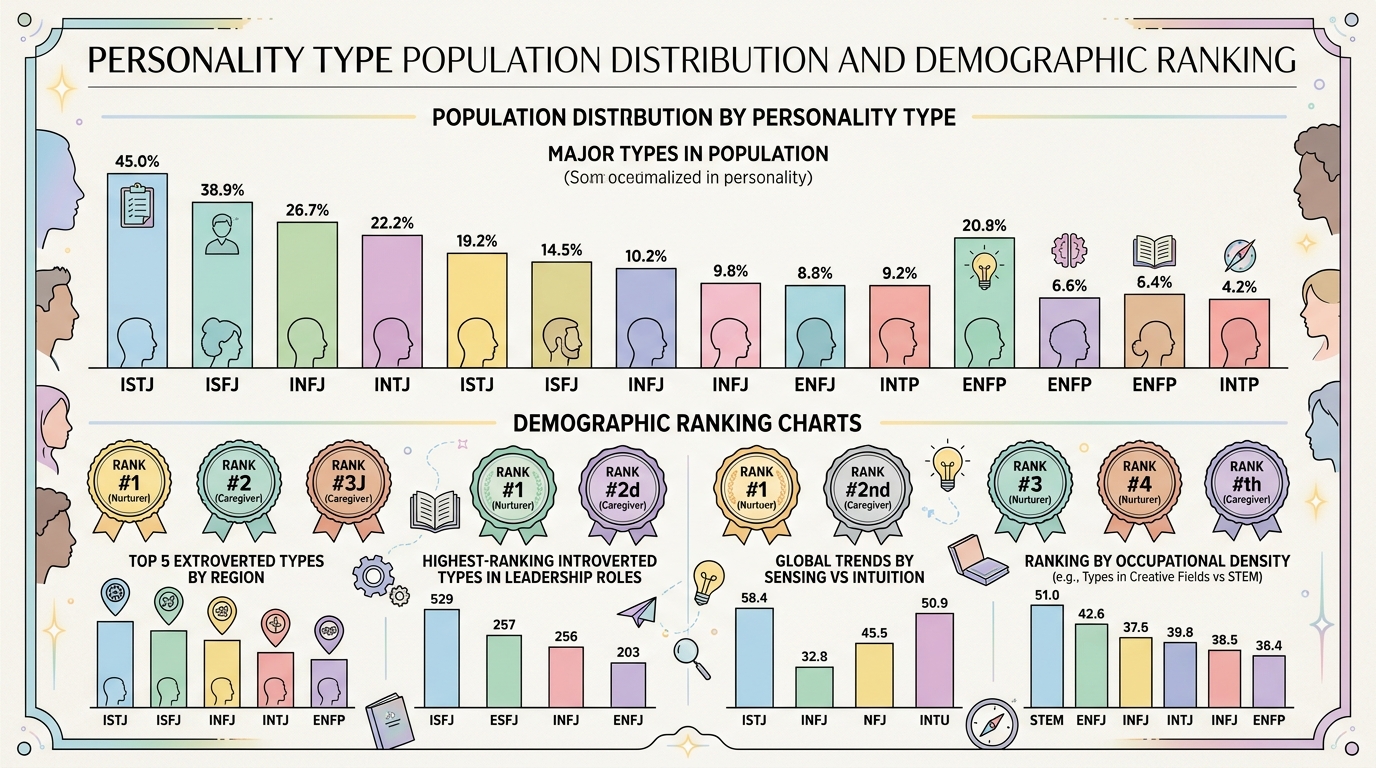
In contrast to Japanese online trends, international demographic benchmarks (such as CAPT and Myers-Briggs Foundation studies) reveal that Sensing-Judging (SJ) types make up over 45% of the global population.
4. The Rarest Personality Types in the World
Intuitive-Thinking (NT) and Intuitive-Feeling (NF) types represent the statistical minority globally:
- INFJ (Advocate): ~1.5% worldwide. The rarest type globally, combining visionary idealism with focused discipline.
- ENTJ (Commander): ~1.8% worldwide. Natural strategic directors with uncompromising standards.
- INTJ (Architect): ~2.1% worldwide. Independent system designers focused on long-term efficiency.
5. Personality Type Correlations with Income and Career
According to labor studies (such as Truity's income surveys), individuals possessing Extraverted Thinking (Te) traits—namely ENTJs, ESTJs, and ENTPs—consistently report the highest average annual income, largely driven by executive leadership roles. Conversely, types prioritizing personal expression and social harmony (like INFPs and ISFPs) often pursue fulfilling non-traditional careers in creative and human-centered fields.
6. Explore the Interactive Rankings Dashboard
Explore dynamic sorting by rarity, population percentage, and average income on our live rankings hub: