"MBTI is astrology for HR" and "MBTI changed my life" are both common opinions. The research sits in between: the MBTI measures real, well-documented personality differences, but it packages them in a way that loses information.
1. The short answer
Key findings
- Four MBTI scales correlate moderately to strongly with four of the Big Five traits (r ≈ 0.44–0.74).
- The MBTI has no scale for Neuroticism (emotional stability), the fifth Big Five trait.
- Scores are continuous and mostly cluster near the middle, so splitting people into 16 fixed "types" is the weakest part of the model.
- Use the Big Five for research and high-stakes decisions; use type language for self-reflection and team communication.
2. The MBTI–Big Five correlation table
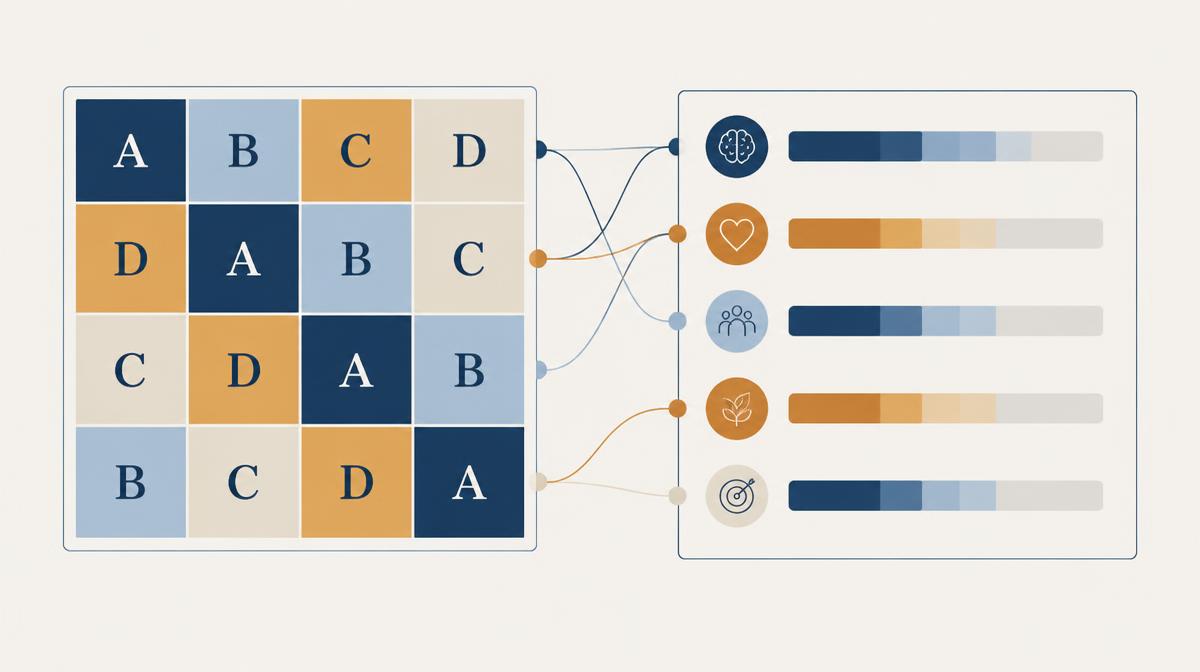
The most cited study is McCrae & Costa (1989), which gave both the MBTI and the NEO Personality Inventory to several hundred adults. Four clear pairings appeared. Values below are the approximate correlations reported for men in that sample (results for women were similar). The sign depends on which end of the scale is scored, so only the strength is shown.
| MBTI scale | Big Five trait | Correlation (|r|) | Strength |
|---|---|---|---|
| Extraversion – Introversion (E/I) | Extraversion | 0.74 | Strong |
| Sensing – Intuition (S/N) | Openness to Experience | 0.72 | Strong |
| Judging – Perceiving (J/P) | Conscientiousness | 0.49 | Moderate |
| Thinking – Feeling (T/F) | Agreeableness | 0.44 | Moderate |
| — (none) | Neuroticism | — | Not measured |
In plain terms: an "N" is, statistically, a person high in Openness; a "J" tends to be high in Conscientiousness; an "F" tends to be high in Agreeableness. Later work, including Furnham (1996), found the same pattern. The MBTI is not measuring something imaginary; it is measuring four of the five traits that mainstream psychology already recognizes.
3. The missing fifth trait: Neuroticism
Neuroticism — how easily someone feels anxiety, stress, and low mood — is one of the strongest predictors of wellbeing in the Big Five. The original MBTI deliberately avoided it, because Isabel Briggs Myers wanted every type to sound positive.
That gap is why some modern online tests add a fifth letter such as "-A" (Assertive) or "-T" (Turbulent). Those letters are essentially a Neuroticism scale added back in. Our test sticks to the four classic dimensions, and we say so on our methodology page.
4. Types vs. traits: the bimodality problem
Type theory assumes people fall into two camps on each scale (a "bimodal" distribution). In practice, MBTI scores form a single bell curve: most people sit near the middle, and few are at the extremes. Someone at 52% Introversion and someone at 48% are almost identical, yet they receive different letters.
This is why we show each dimension as a percentage on your results, not just a letter. A score near 50% means a weak preference, and the letter on that scale should be held lightly.
5. Reliability: why your letters change
Studies summarised in Capraro & Capraro (2002) report reasonable internal consistency and test-retest reliability for the continuous MBTI scores, roughly in the 0.7–0.8 range for most scales. Yet around a third to half of people get at least one different letter on retest within weeks (Pittenger, 1993).
Both are true at once: the scores are fairly stable, but people near the midpoint cross it easily. If your type changes between attempts, look at which scale was close to 50% — that is almost always the letter that flipped.
6. When to use which model
| Goal | Better fit | Why |
|---|---|---|
| Hiring or selection | Big Five (or neither) | Stronger evidence; the MBTI publisher advises against selection use |
| Clinical or wellbeing screening | Big Five / clinical tools | Includes Neuroticism |
| Academic research | Big Five | Continuous, widely replicated |
| Team communication workshops | MBTI-style types | Memorable shared language, non-judgemental framing |
| Self-reflection, relationships | Either | Types are easier to discuss; traits are more precise |
7. Sources
- McCrae, R. R., & Costa, P. T. (1989). Reinterpreting the Myers-Briggs Type Indicator from the perspective of the five-factor model of personality. Journal of Personality, 57(1), 17–40.
- Furnham, A. (1996). The big five versus the big four: the relationship between the Myers-Briggs Type Indicator (MBTI) and NEO-PI five factor model of personality. Personality and Individual Differences, 21(2), 303–307.
- Capraro, R. M., & Capraro, M. M. (2002). Myers-Briggs Type Indicator score reliability across studies: a meta-analytic reliability generalization study. Educational and Psychological Measurement, 62(4), 590–602.
- Pittenger, D. J. (1993). Measuring the MBTI… and coming up short. Journal of Career Planning and Employment, 54(1), 48–52.
This article is an educational summary. MBTI and Myers-Briggs Type Indicator are trademarks of The Myers-Briggs Company; this site is not affiliated with it.